Wednesday, February 23, 2011

Kyle-Wednesday, 2/23 Solubitity

1) We got our ChemThink Homework stamped by Mr. Tucker.

2) We went over problem #5 on the Solubility Practice worksheet.
  • NaNO3(aq) + AgNO3(aq) ------> NaNO3(aq) + AqNO3(aq)
  • Their is no reaction because all four coumpounds are soluble in water(aq).
  • You just put a line through the problem or say NR.
3) We also did a Solubility Lab in which we mixed six different solutions with each other and we watched to see if their was a reaction. We made a 6 by 6 grid with the solutions and their reactions. If their is an X through one that means we didn't try the solutiuon. NR means no reaction and Rxn means a reaction occured. Here is the chart we did in class.


MgCl2

K3PO4

NaNO3

Na2CO3

AgNO3

CuSO4

MgCl2

X

X

X

X

X

X

K3PO4

Rxn-Cloudy color

X

X

X

X

X

NaNO3

NR

NR

X

X

X

X

Na2CO3

Rxn-Cloudy color


NR


NR

X

X

X

AgNO3

Rxn-Cloudy color

Rxn-turned yellow


NR

Rxn-Cloudy color

X

X

CuSO4

NR

Rxn-Cloudy color


NR

Rxn-Cloudy color


NR

X


Here are some examples of a reaction taking place. Make sure to use the Solubility Rules worksheet as a cheat cheat. Notice how one product is a solid(s) and the other is aqueous(aq).
  1. K3PO4(aq) + 3MgCl2(aq) ------> 6KCl(aq) + Mg3(PO4)2(s)
  2. Na2CO3(aq) + MgCl2(aq) ------> 2NaCl(aq) + MgCO3(s)
  3. 2AgNO3(aq) + MgCl2(aq) -------> 2AgCl(s) + Mg(NO3)2(aq)
  4. 3AgNO3(aq) + K3PO4(aq) -------> Ag3PO4(s) + KNO3(aq)
  5. 3CuSO4(aq) + K3PO4(aq) -------> Cu3PO4(s) + 3KSO4(aq)
Now here are a couple examples of no reactions or NR. Notice how the products are both aqueous(aq).
  1. 2NaNO3(aq) + MgCl2(aq) -----> 2NaCl(aq) + Mg(NO3)2(aq)
  2. AgNo3(aq) + NaNO3(aq) -------> AgNO3(aq) + NaNO3(aq)

4. The last thing we did today was get a sheet called Solution Stoich 1. Mr. Tucker went over problem #3a. For homework we have to try problem 3b.

3a. What volume of 0.150 M AgNO3 is needed to react with 45.0 mL of 1.50 M CaCl2?

3b. What mass of AgCl will be produced when 150mL of 0.650 M CaCl2 reacts?


Tuesday, February 22, 2011

Natalie- Tuesday, 2/22


1) We picked up one sheet: ChemThink Precipitate Lab

2) We went over lab quiz we took on friday
  • Molarity= unit of concentration
  • Use formula to determine how many mols of solute needed to make 0.15 M of solution
  • If you need help with the formula use this video as a reference: http://www.youtube.com/watch?v=8oTqwBAvbnY&feature=fvwrel

  • .015 mol NaCl

    58.44g NaCl

    1 mol NaCl


  • Fill beaker with 50 mL of water
  • Then mix in .88g of Solute (NaCl)
  • Then fill rest of the beaker to 100 mL
3) Went through IV. Solubility Notes
  • Soluble in water= dissolves in water (aqueous)
  • In soluble= does not dissolve in water (solid)
  • There are some exceptions though, mentioned on the sheet
4) Went through V. Solubility Practice #1-3:
  • If the balanced equation has aqueous on both sides, then no reaction has taken place
5) Homework are questions #1 and #2 on the ChemThink precipitate lab sheet we picked up in
class. Use www.chemthink.com to answer the questions under Solubility


Monday, February 21, 2011

Shayne - Friday, 2/18

I. We picked up two sheets at the beginning of class - (Molarity 2 and Reaction Stability 1)

II. We went through the Molarity 2 notes:

EXAMPLES:

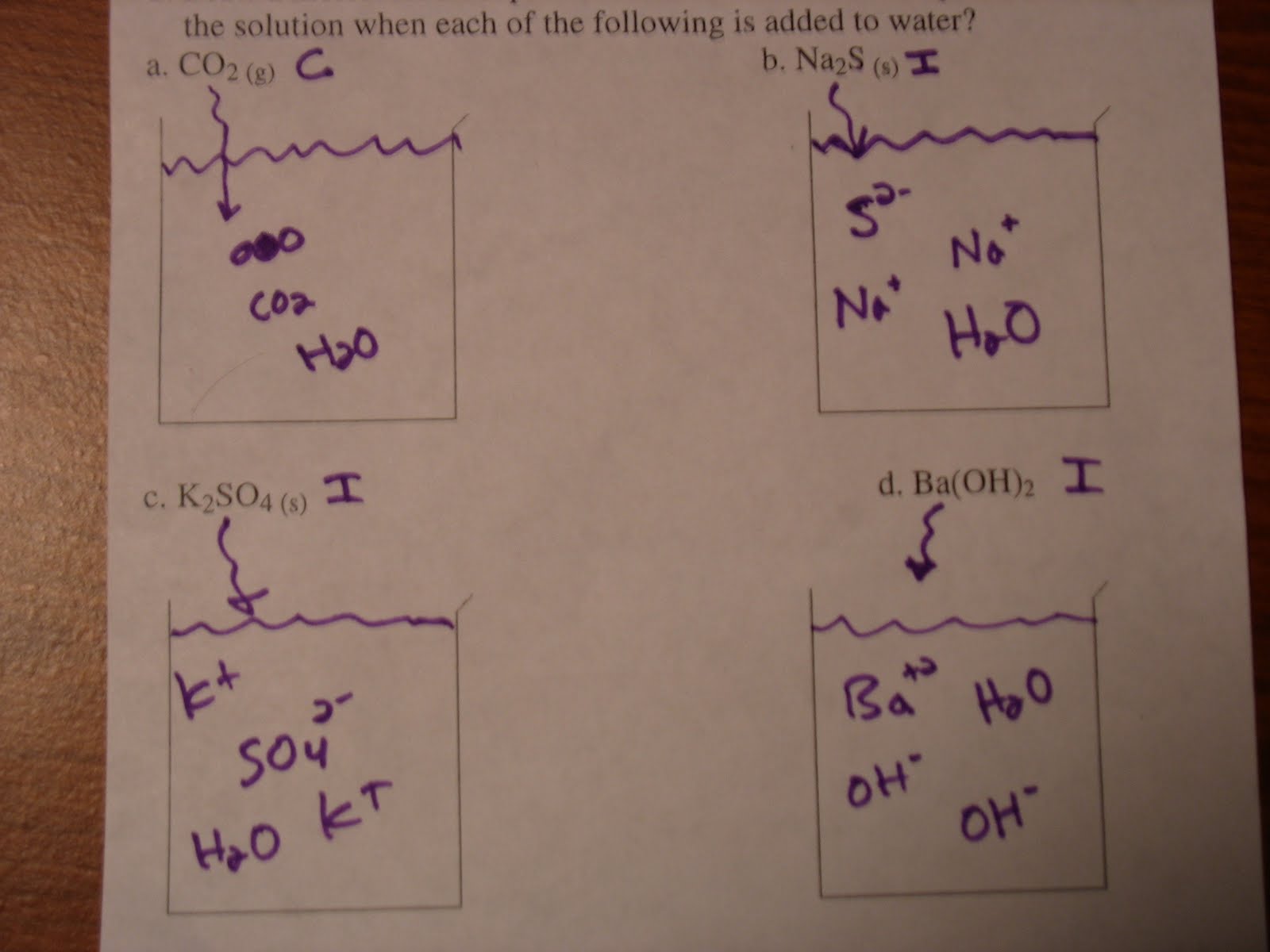
1.) What will be actually present in the solution when each of the following is added to water?

a. KCL ----------> K+ (aq) plus Cl- (aq)
b. NaNO3 ----------> Na+ (aq) plus NO3- (aq)
c. C2H6O ----------> C2H6O (aq)

3.) Calculate the mlarity (M) of the following solutions. (M = Mol/L)

a. M = 0.0346 Mols/0.250 Liters = 0.138M
b. (405 g NiCl2 X 1 mol NiCl2)/129.59 g NiCl2 = 3.12524 mols NiCl2
M = 3.12524 Mols/7.54 Liters = 0.414M
c. (22.57 g H2SO4 X 1 mol H2SO4)/98.09 g H2SO4 = 0.23009 mols H2SO4
100 Ml = 0.1 L so.....
M = 0.23009 Mols/0.1 L = 2.301M

5.) Calculate the mass of the solute present in the following solutions.

a. Mol = M x L so...
0.125M x 0.200L = (0.25 Mols Kbr x 119 g KBr)/1 Mol KBr = 2.98 g KBr
b. Mol = M x L so...
Mol = 0.150M x 0.1L
(0.015 Mols Na2SO4 x 126.05 g Na2SO4)/1 mol Na2SO4 = 1.89 g Na2SO4

III. We took a lab test in groups of two, having to make a solution of 0.15M of NaCl and show calculations

Thursday, February 17, 2011

Th-2/17-Gabuzzi


1. We picked up 2 sheets.

  • Molarity 1
  • Dissolving 1

2. We took a quiz on the mixtures notes we took on wednesday.

3. We then review the different types of substances and mixtures.

4. We finished the Solution Notes

III. Solutions . (we used salt water as an example)

A. Solute- dissolved (salt)

B. Solvent- doing dissolving (water)

C. Solution- solute and solvent (mixture of salt water)

D. Concentration of solution:

M=molarity

M= 1 mol solute per liter of solution. 1.0m=1 moler.

E. Preparation of solution:

  1. find total volume
  2. fill container 1/2 way with solvent
  3. add a solute and mix
  4. fill container to desired volume with solvent

We filled out the Molarity 1 and Dissolving 1 Worksheets (see photos at top for answers)

Homework: Finish Molarity 1 worksheet or we will be doing webassigns for the rest of the year.

Wednesday, February 16, 2011

Wednesday, February 16

1. Pick up 6 sheets:
  • 4 pages of Solutions Notes
  • 2 pages of Mixtures Lab
2. Got Lab Test and Stoich Test back

3. Started the Mixtures lab

There are 4 unknown liquids as shown below


(liquids in order left to right)

they must be observed based on:
  1. how they look
  2. what happens when shaken
  3. whether there is an odor
  4. whether a light shines through or not
  5. how quickly it filters

(all 4 liquids being filtered)

6. what's left when liquid evaporates

4. Data:
  1. look at picture above
  2. unknown 1: stays the same, unknown 2: same, unknown 3: mixes but settles, unknown 4: same
  3. none had much of an odor
  4. light shined through unknowns 2 and 4 but not 1 and 3
  5. 2 and 4 filtered quickly. 1 and 3 filtered slowly
  6. unknown 1: white powder, unknown 2: blue residue, unknown 3: muddy paste, unknown 4: evaporated clean
5. Solution notes

I. Types of Substances:

A. Pure - can be one substance

B. Mixtures - can be more than one substance

C. Examples:
  1. mixture
  2. mixture
  3. pure
II. Types of Mixtures:

A. Solutions
  • shake - no change
  • uniform
  • light passes through
  • everything goes through filter
  • evaporate - residue
B. Suspensions
  • shake - change
  • settling
  • light does not go through (Tyndall Effect)
  • substance is filtered out
  • evaporate - residue
C. Colloids
  • shake - no change
  • does not settle
  • Tyndall Effect
  • everything goes through filter
  • evaporate - residue

Sunday, February 13, 2011

Thursday February 10 2011-Matt Ploetz


1)We went over our Quiz 5.


2) We then learned about Percent Yield and did one problem on it. (See Pictures)
3) Then we worked more on our Penny Lab.
4) We took Quiz 6.


Wednesday, February 9, 2011

Wednesday, February 9, 2011, David Colston

1)First, we picked up two new worksheets. The page numbers were 33 and 34, and they had the same title: Limiting Reactants 4

2) We then proceeded to go over the Penny lab we did in class. In the Penny Lab, we put the CuCl2 and the nails in water and stirred it up. After stirring it for a while, the blue-tint to the water caused by the Copper Chloride disintegrated, and the water remained there. By this we know that CuCl2 is the limiting reactant, but you can also do this by writing the problem out like this:

First you must balance the equation, so it would be:

3CuCl2 + 2Al ----> 2AlCl3 + 3Cu

Then, you need to put your data in your tables:

3.0 grams CuCl2

1 Mole CuCl2

3 Mole Cu

63.55 grams Cu

134.45 grams CuCl2

3 Mole CuCl2

1 Mole Cu


Answer: 1.417 grams Cu - We know this is the limiting reactant because CuCl2 has less then the Excess reactant, Al

1.25 grams Al

1 Mole Al

3 Mole Cu

63.55 grams Cu

26.98 grams Al

2 Mole Al

1 Mole Cu


Answer: 4.416 grams Cu - Excess Reactant... Can only make as much as the limiting reactant though, so it can only make about 1.4 grams of CuCl2

To answer the second question, we can go backwards from grams needed to grams CuCl2.

3) We went over quiz number 4
A.

12.5 grams Al

1 Mole Al

2 Mole Al2O3

101.96 grams Al2O3

26.98 grams Al

4 Mole Al

1 Mole Al2O3

12.5 grams O2

1 Mole O2

2 Mole Al2O3

101.96 grams Al2O3

32.00 grams O2

3 Mole O2

1 Mole Al2O3


Answers
A. 23.6 grams Al2O3 = Limiting Reactant
and
26.6 grams Al2O3 = Excess Reactant

B. The mass of the product can only be as much as its limiting reactant, so it would equal 23.6 grams

4) We went over a problem on page 33

Problem Number 2: 2NH3 +5F2 ----> N2F4 +6HF

If 120 g of NH3 is allowed to react with 590 g of F2,

What mass of HF can be formed?

120 grams NH3

1 Mole NH3

6 Mole HF

2 grams HF

17.04 grams NH3

2 Mole NH3

1 Mole HF


Answer =422.7 grams HF or 420 grams HF (Sig Figs)

590 grams F2

1 Mole F2

6 Mole HF

20.01 grams HF

38 grams F2

5 Mole F2

1 Mole HF


Answer= 372.8 grams HF or 370 grams HF (Sig Figs)
Limiting Reactant

What is the Excess Reactant?

372.8 grams HF

1 Mole HF

2 Mole NH3

17.04 grams NH3

20.01 grams HF

6 Mole HF

1 Mole NH3


120 grams NH3 -105.8 grams NH3=14.2 grams NH3 or 14 grams NH3 (Sig figs)


5) We took Quiz Number 5, covering the things that we learned in class today (That are on here)

6) We went over the newest Lab, that is just one day out of our 3 day lab test. If you missed yesterday, you may want to see Mr. Tucker, but it isn't the end of the world seeing as we only spent about 10 minutes on it. What we began to do was: We put the CuCl2 and the nails in water and stirred it up. The nails become a rusty gray color. We will work more on this in class tomorrow.

HOMEWORK/NOTES: PREPARE FOR QUIZ, AND FUTURE QUIZZES. IF YOU DON'T UNDERSTAND SOMETHING, GO OVER IT OR GET HELP WITH MR. TUCKER, A FELLOW CLASSMATE OR IN THE TLC. DO AS MUCH OF PAGE 33 and 34 AS POSSIBLE. THINK ABOUT THE LAB EXAM!!!

If you read this, thank you! I hope it was a help!